“We need to ban ChatGPT to protect the company” is becoming “We banned ChatGPT and lost our two best senior engineers.” The career risk has flipped.
A blanket AI ban used to look prudent. In 2025 and 2026, it can make you look slow, blind, and expensive.
Your engineers are not comparing your security posture to a policy memo from 2023. They are comparing it to the company down the street that gives them Claude, Copilot, and ChatGPT with guardrails.
In 2025 developer surveys, access to AI tooling is consistently a top-five job criterion, behind only compensation and flexibility. That matters. Senior engineers do not leave over one policy alone, but they add “modern tooling” to the list when they decide whether to stay.
The numbers are ugly. Replacing one senior engineer in the US, UK, or Western Europe often lands in the $50,000 to $80,000 range once you include recruiter fees, interview time, sign-on cost, onboarding drag, and manager attention.
Then you wait another 3 to 6 months before that person is fully productive in your codebase and your incidents. Lose two strong seniors because your answer to AI was “no,” and you have created a six-figure problem before the security gain is even proven.
Often, it is not proven at all.
A ban does not remove the urge to paste. It removes the audit trail.
We have real-world finance-team data showing that roughly 37% of ChatGPT prompts contained sensitive data. That is the point most policy discussions miss.
People paste sensitive material when they are under deadline, cleaning up a client note, summarising a board pack, or fixing a nasty incident. If you block the sanctioned path without offering a controlled one, the same behaviour moves to personal phones and home laptops. The copying continues. Your visibility does not.
That is a bad trade. You moved from managed risk to unobserved risk.
The off-log prompts are not theoretical. They look like this:
[personal iPhone] Here's our sprint planning notes — can you turn into a one-pager?[personal laptop, home wifi] Summarise this on-call runbook for a new team member — here's the version from our internal wiki...[personal Gmail account on home MacBook] Clean up this customer escalation draft and remove the angry tone before I send it to the VP.None of that is safer because your corporate laptop shows zero AI usage.
That is the trap. A ban gives you a cleaner dashboard only because the activity has left the dashboard.
For a CISO, this is where the career risk starts. If an incident lands later and the investigation finds staff were using personal devices because the company banned approved tools, your decision will not read as disciplined. It will read as avoidance.
You chose ignorance over control.
There is a better pattern, and it is not new. It is the old CISO playbook applied to a new channel: graduated controls that let the work happen, classify the exposure, and log the event without storing the sensitive payload.
That means you do not treat every prompt the same. Low-risk prompts can pass. Medium-risk prompts can trigger a warning and require user confirmation. High-risk prompts can be blocked outright when they include regulated data, client financials, or internal confidential material.
You preserve productivity, and you preserve evidence.
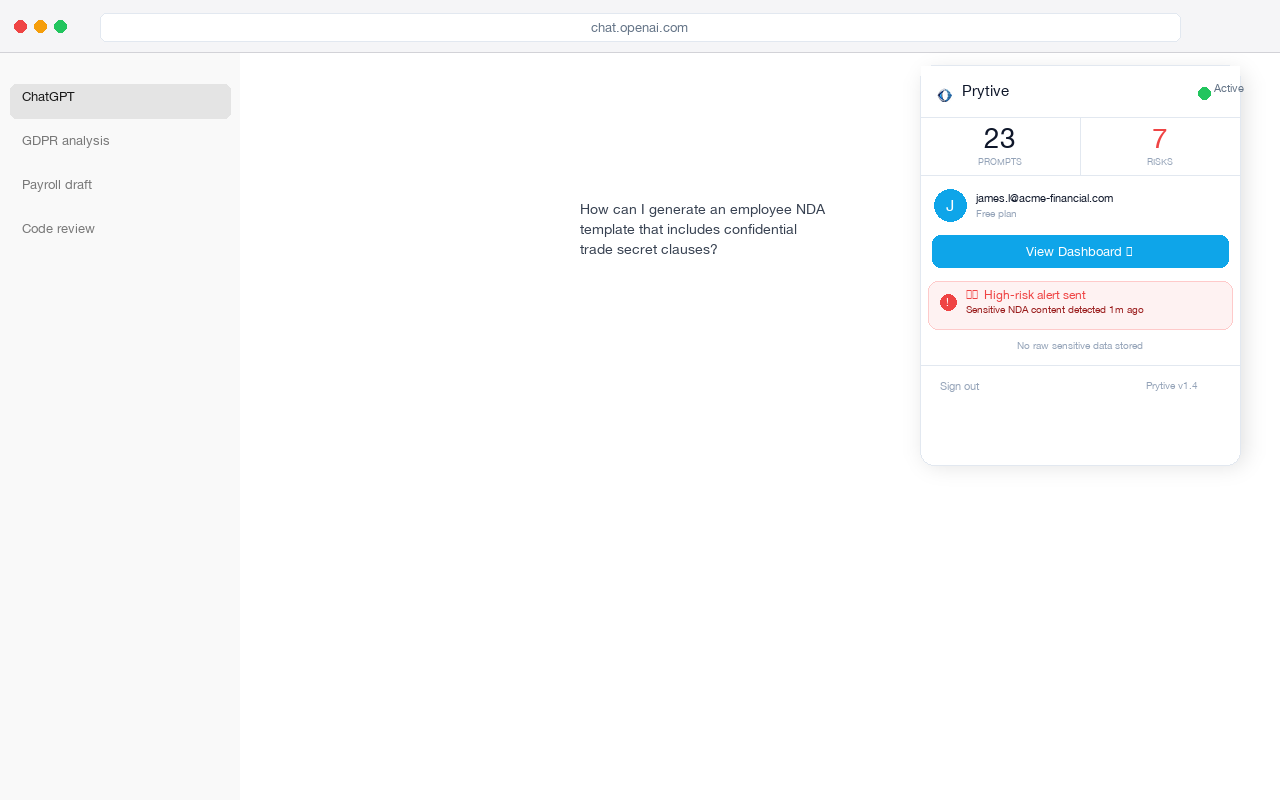
This model fits how risk frameworks already work. You do not ban email because phishing exists. You filter, monitor, quarantine, and train. You do not ban cloud storage because staff might upload a contract. You segment access, watch exfiltration paths, and keep logs.
AI should be handled the same way.
The legal case for visibility is getting tighter too. Under GDPR Article 5(1)(f), you are expected to protect personal data against unauthorised processing. Under Article 32, you need appropriate technical and organisational measures based on risk. In healthcare, the HIPAA Security Rule at 45 CFR §164.312 calls for audit controls and transmission safeguards.
Those requirements point toward monitored usage with enforcement. They do not point toward a policy that pushes data onto a personal device and leaves you with nothing to review.
If you are a CIO or People-Ops leader, the same logic holds from a different angle. A ban signals that your company cannot adapt tooling safely. Senior candidates notice. Existing engineers notice faster.
They may tolerate weaker perks or a slower promotion cycle for a while. They do not tolerate being told to build 2026 systems with 2022 tools.
You do not need an AI free-for-all. You need a four-layer alternative to a ban.
The 4-layer alternative that closes risk and keeps the engineers
1. Browser-layer interception
Most AI usage happens in the browser, outside legacy DLP paths. Inspect prompts where they are typed. Catch PII, financial data, secrets, and confidential text before they leave the page.
2. Graduated policy enforcement
Set thresholds. Warn on medium-risk content. Block high-risk content. Allow low-risk use so your team can still draft, summarise, and code at speed.
3. Redacted audit logging
Log the event, the category, the user, the destination tool, and the action taken. Do not store the raw sensitive content. You need proof of control without creating a second data spill inside your own logs.
4. Team-level reporting and coaching
Look for patterns by function and risk type. Finance may paste board material. Support may paste tickets with account data. Engineers may paste runbooks or internal docs.
Tune the policy and train the team using what actually happens, not what you guessed would happen.
That is a control plane. It is practical. It also gives you something defensible to say in front of the board: we did not ban productivity tools and hope for the best; we allowed the work and instrumented the risk.
On Friday afternoon, a blanket ChatGPT ban still feels like decisive leadership. By Monday morning, it can look like a retention mistake with no telemetry.
Do not confuse silence with safety.
If you want a clean way to make the case internally, use data from a 14-day Prytive pilot to show how much AI usage is already happening, what categories carry risk, and where graduated controls beat a ban in both security and engineer retention.