Most compliance programmes assume the risk sits with junior staff. In AI-channel exposure, that assumption breaks first at the top.
In management consulting, the highest exposure often sits with partners and engagement leads. They hold the broadest access to client material. They work under the hardest turnaround pressure. And they are the least likely to hesitate before trying “just the summary tool” on a live deck at 11pm.
That inversion matters because consulting firms do not handle generic internal documents. Nearly every engagement is wrapped in an NDA.
The underlying material is often market-sensitive, commercially sensitive, or both: acquisition targets, pricing models, operating margins, headcount plans, restructuring scenarios, negotiation positions. If that content is pasted into ChatGPT, Gemini, Copilot, or Claude without review, your risk is not theoretical. It is contractual.
The management consulting ChatGPT client confidentiality NDA problem is simple: the people under the most pressure to use AI are often the people with access to the most expensive material.
A junior analyst may have one workstream. A partner may have six live client situations open, a board deck due at 8am, and a half-finished set of notes from a CEO call. That is the profile most likely to paste first and think later.
A common failure point looks banal. A partner is rewriting a client deck late at night. They want cleaner wording, a tighter executive summary, better slide titles. So they paste five slides of client strategy into a public LLM prompt box. The model may return a useful draft in 20 seconds. The confidentiality issue happened in the first second.
!Prytive popup showing a high-risk prompt flagged for confidential material
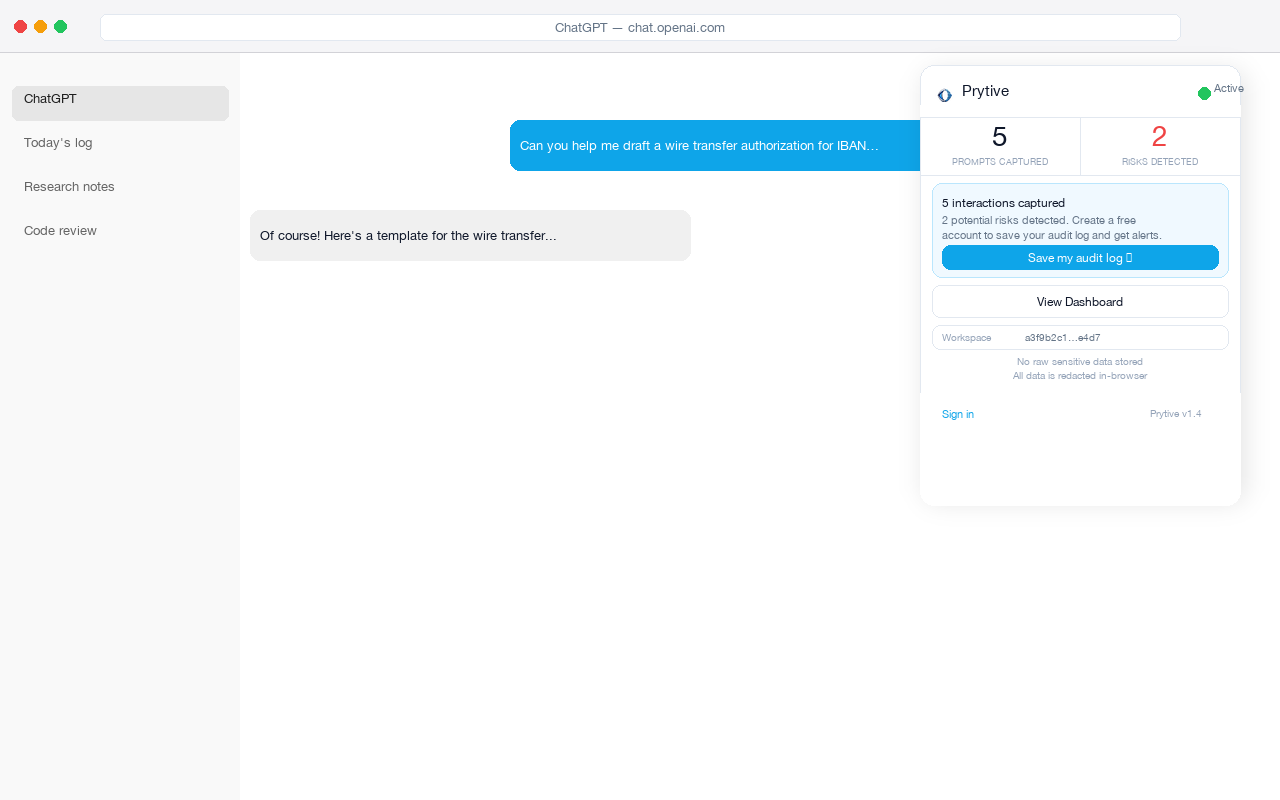
This is where firms get caught by old assumptions. Traditional controls were built for email, file transfer, and endpoint storage. They were not built for a browser prompt box receiving a client’s strategic roadmap, redline comments, and draft recommendations in one paste event.
The contract layer is usually the first real shock. Many consulting NDAs are not limited to vague confidentiality wording. They include breach notification duties, processor restrictions, and material-adverse-breach clauses that give the client termination rights.
In some cases, that also means fee clawback. If your firm used an unauthorised third-party processor for client confidential information, the client does not need to debate whether the summary was helpful. They can point to the clause.
That matters more in consulting than in many sectors because the value of the work product is so concentrated. One paste can contain the whole commercial thesis of the engagement.
Consider the kinds of prompts people actually type:
Summarise this client's strategic roadmap for the Monday board deck — they're [company name], considering [acquisition target], rationale [...]That single prompt can expose the client identity, the target, and deal rationale. If the acquisition is not public, you have moved from confidentiality risk into market abuse territory.
On M&A advisory work, the risk sharpens further. Pasting a target company’s financials into ChatGPT before deal announcement can create insider-information exposure. In the UK, that lands you in the scope of the UK Market Abuse Regulation, Article 7, which defines inside information by reference to precise, non-public information likely to have a significant effect on price. In the EU, the same issue sits under Market Abuse Regulation (EU) No 596/2014, Article 7. The prompt does not need to be malicious. Careless handling is enough to create a serious problem.
The same pattern shows up in organisation and cost work:
Take this org chart and suggest a reorg for cost reduction: [partner firm, names, salaries, revenue contribution]That is not harmless “internal use”. It can contain personal data, pay data, performance data, and confidential operating structure in one shot. If any of it relates to identifiable individuals, UK GDPR Article 5(1)(f) and GDPR Article 5(1)(f) on integrity and confidentiality come into play. If your lawful basis, transparency position, or processor controls are weak, the client’s legal team has a short route to escalation.
Interview synthesis is another trap because people believe anonymisation is happening when it is not:
Turn these three client interview transcripts into anonymised insights for the final report — but keep the direct quotes.If the quotes are verbatim and identifying, you have not anonymised anything. You have just asked a model to retain the identifying details in a cleaner format.
Insurance is the next blind spot. Plenty of firms assume professional-liability cover will absorb the damage if a client claims loss. That assumption needs checking.
Some errors and omissions policies exclude incidents involving unauthorised third-party processors, or they narrow cover where the insured failed to follow contractual data-handling requirements. If your engagement terms forbid disclosure to external tools and someone pastes into one anyway, the coverage debate starts exactly when you do not want it.
This is why partner-level AI use deserves special scrutiny. The exposure is compounded by speed. A partner rewriting a deck at 11pm is not opening the data handling policy. They are trying to get slide 14 into shape before the steering committee.
The workflow is fast, solitary, and high stakes. Those are the conditions under which confidential material leaves the browser in seconds.
A useful control has to fit that reality. If it adds enough friction to slow every piece of drafting work, senior staff will route around it. If it does nothing at the point of paste, it misses the failure mode.
Controls partners will actually tolerate
- Browser-level intervention on prompts
Put the control where the leak happens: the prompt box. If someone pastes client names, deal terms, pricing, financials, or identifiable personnel data into ChatGPT or Gemini, the warning needs to appear before the content leaves the device. High-risk prompts should block. Lower-risk prompts can warn and require justification.
- Redacted audit logs, not raw prompt storage
You need evidence without creating a second confidentiality problem. Keep the audit trail, but log redacted versions only. Risk leads need to see that a partner attempted to paste M&A financials or named employee salary data. They do not need the raw material copied into another system.
- Tighter rules for specific engagement types
Do not write one generic “AI acceptable use” policy and call it done. M&A, restructuring, pricing, litigation support, and board strategy work need stricter handling rules because the downside is larger. Spell out that unpublished deal information, target financials, named employee data, and verbatim client interview quotes cannot be entered into public LLMs without approved controls. Make the rule short enough that a partner can remember it.
This is not an argument against AI use in consulting. It is an argument against pretending the risk sits with the most junior person in the room.
In many firms, the opposite is true. The person with the most client access and the least time is often the highest-risk user.
Start there. Pilot on the top five engagement leads, measure block rates and false positives for 30 days, and prove the friction is tolerable before firm-wide rollout. If you want to see what that browser-layer control looks like in practice, Prytive is built for exactly that gap.