It is 4:47 p.m. on Friday. A clinic is angry. The ticket has a patient list attached. Your rep pastes it into ChatGPT.
That moment feels small. It rarely stays small.
For healthcare SaaS support teams, the risky prompt is usually not dramatic. It is admin work under deadline pressure: clean up a list, summarise a thread, draft a reply, spot a pattern in failed records. The rep is trying to get a clinic live again before close of business.
They are not trying to mishandle PHI. But intent does not matter much once protected health information leaves your approved boundary.
These are the kinds of prompts that create the problem:
Can you reformat this patient list as a table? Each row has: name, DOB, condition, last appointment. [attaches 47 patient records from clinic email]Draft a polite reply to this clinic complaining about sync errors — here's their ticket history including the patient IDs they mentioned: [...]What could cause these treatment codes to fail sync? [paste of ICD-10 codes + patient MRNs from the clinic's file]One paste can trigger three independent clocks.
First, the HIPAA Breach Notification Rule under 45 CFR §§ 164.400-414. If PHI is disclosed to a third party that is not covered by your Business Associate Agreement, you are into breach analysis immediately.
Second, GDPR Article 33. If any clinic customers are in the EU, and the prompt includes Article 9 special-category health data, the controller may need to notify the supervisory authority within 72 hours of becoming aware of a personal data breach.
Third, your own BAA contractual obligations. Many healthcare SaaS vendors commit to notify covered entities within a set window such as 24 hours, 48 hours, or "without undue delay."
Those clocks usually do not start when the rep pastes the prompt. They start when your company becomes aware.
That distinction matters because support teams often discover these incidents late. The prompt sits in browser history, a vendor log, or an employee's copied text trail. Nobody escalates it because nobody sees it.
In one case, the compliance lead only learned about the paste three weeks later during a ticket review. By then, the HIPAA analysis was behind, the GDPR Article 33 72-hour window had long passed for affected EU clinic data, and the company had already missed the notice period promised in its BAA.
This is also where the HIPAA minimum necessary standard breaks down. Under 45 CFR § 164.502(b), your workforce must make reasonable efforts to limit PHI to the minimum necessary to accomplish the intended purpose. If a rep needs help drafting a reply about one patient's sync failure, pasting 47 patient records is not a close call.
It is excessive on its face. Name, date of birth, condition, appointment history, patient identifiers — all of it went out when one affected patient, or better yet de-identified facts, would have been enough.
The vendor processing point matters too. OpenAI has stated that for free and standard API users, submitted content may be retained for up to 30 days for abuse monitoring. Regulators tend to view that as continued processing, not a vanishing transmission.
So even if the rep deletes the chat five minutes later, your incident analysis still has to account for onward handling by a non-BA third party during that retention period.
Most teams respond to this with training. Another slide. Another annual reminder not to paste PHI into public AI tools. It helps a bit.
Then Friday happens again.
Training fails because awareness is not the bottleneck. Your rep already knows patient data is sensitive. What they need is a control at the exact moment they are about to send it.
The control pattern that works is straightforward: detect high-risk health data in the browser, warn at send time, and keep a redacted audit trail so compliance can act fast without storing raw PHI. Not blanket blocking. Not a policy PDF buried in your wiki.
Timed friction.
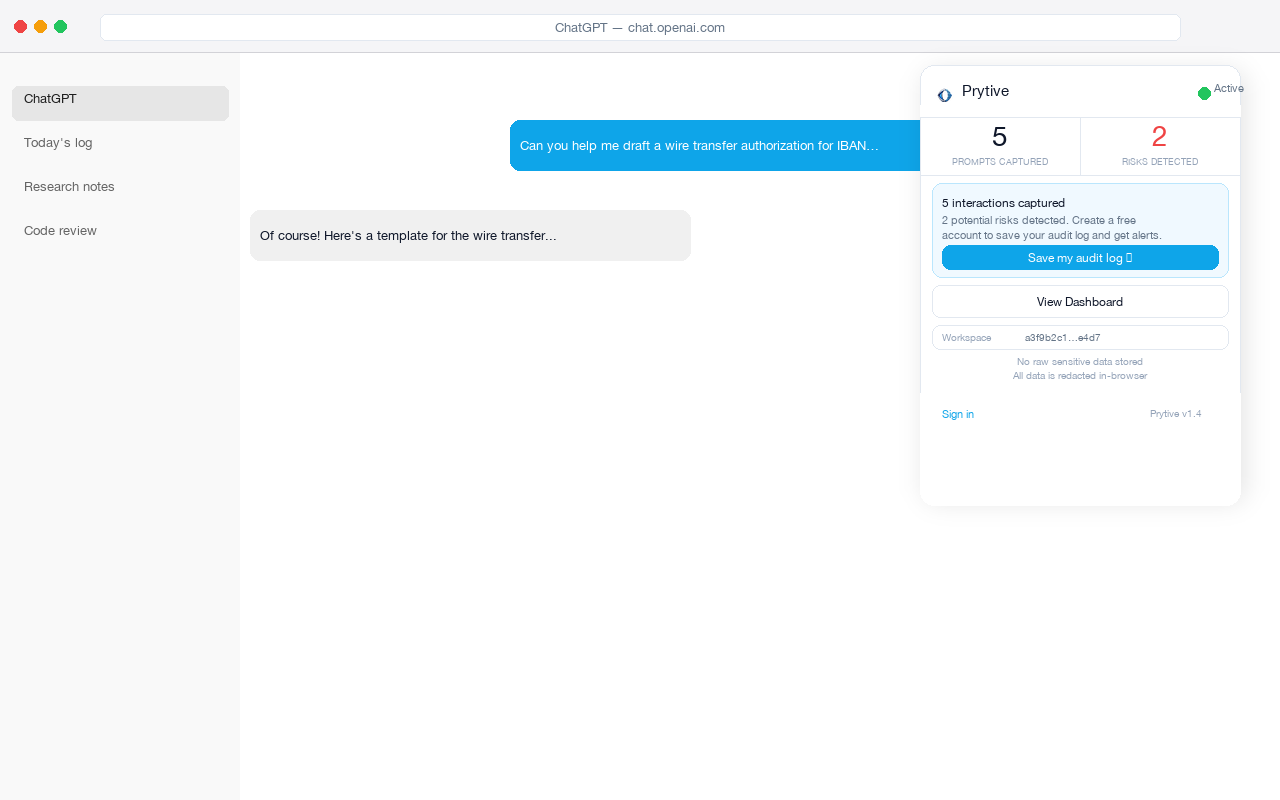
That warning changes the rep's behaviour because it shows up inside the workflow they are using. They see that the prompt contains health data. They stop.
They trim it down to the one affected patient. Or they remove identifiers entirely and ask the model about the sync logic instead of the patient records. If they continue anyway, you have a redacted log and a timestamp.
Your compliance team is no longer blind for three weeks.
The practical lesson for compliance managers is simple: your incident timeline is only as good as your detection point. If your first reliable signal arrives days later from an internal review, your 72-hour window under GDPR Article 33 is already in trouble. If your BAA requires notice within 24 hours of discovery, late discovery becomes a contract failure.
If you cannot show what data categories were involved because nobody logged the event safely, your HIPAA risk assessment gets slower and weaker.
72-hour response checklist
- Freeze the facts. Identify the exact prompt, user, timestamp, tool used, and whether attachments were included.
- Classify the data. Confirm whether the prompt contained PHI, and whether EU clinic data or Article 9 health data was involved.
- Check vendor status. Determine whether the AI provider was covered by a signed Business Associate Agreement. If not, treat it as an impermissible disclosure until your counsel says otherwise.
- Measure scope. Count affected patients, data elements, clinics, and jurisdictions. Do not accept "just a support ticket" as an answer.
- Assess minimum necessary. Document why the shared data exceeded the purpose. Regulators look for this.
- Review retention and deletion. If the tool may retain submitted content for up to 30 days, include that in the incident record and any notice analysis.
- Trigger legal review for HIPAA Breach Notification Rule, GDPR Article 33, and BAA contractual obligations in parallel. These are separate tracks.
- Notify internal owners fast: compliance, security, legal, support leadership, and the account owner for the affected clinic.
- Preserve evidence. Save screenshots, browser telemetry, and the redacted prompt record. Do not rely on employee memory.
- Decide on notification deadlines based on awareness time, not the original paste time.
What to instrument before the next Friday incident
You need visibility before you need a breach memo.
Instrument browser-level detection for prompts sent to ChatGPT, Copilot, Gemini, and Claude. Flag health data, patient identifiers, financial data, and confidential clinic material before submission. Show a warning that forces a moment of choice.
Log only redacted versions for audit. Map events to user identity and team. Review weekly patterns by rep, clinic, and category so you can fix workflows, not just punish mistakes.
Also tighten the support process itself. Strip ticket exports down to the affected record. Remove attachments from copied text by default. Give reps approved prompt templates that ask for help with structure or troubleshooting logic without including identifiers.
Small design choices beat annual reminders.
If you manage compliance at a healthcare SaaS company, this is not an abstract AI policy problem. It is a customer support workflow problem with regulatory consequences. One Friday paste can put HIPAA, GDPR Article 33, and your BAA on the clock at once.
The worst part is not the paste. It is discovering it too late.
Pilot Prytive on 5 CS reps for 14 days and see what actually surfaces before the next incident.