Compliance managers tell us this every week.
"It was just for testing." "They anonymised it first." "They only pasted a part of it." "It was a personal account, not the company." "They didn't save the response."
None of these change the analysis. Across every major data protection regime in 2026, the moment personal data is submitted to a third-party AI tool, the disclosure event has occurred. What follows are notification clocks, regulator letters, and conversations with auditors.
The contrarian claim of this piece: intent is not a control. Most teams build their AI compliance posture on assumptions about employee behaviour. The regulations were written with no patience for that.
What "exposure" actually means under four regimes
Four jurisdictions, four definitions, one shared conclusion.
UK and EU GDPR
Article 4 defines processing as "any operation... performed on personal data... such as collection, recording, organisation, structuring, storage, [...] disclosure by transmission, dissemination or otherwise making available."
A paste into ChatGPT is disclosure by transmission. OpenAI is a third-party processor. If there is no DPA, the disclosure is unauthorised. Article 33 starts the 72-hour clock the moment the controller becomes aware.
Canada — PIPEDA
PIPEDA's Schedule 1, Principle 4.7 (Safeguards), requires "appropriate to the sensitivity of the information." Section 7(3) governs disclosure without consent — the list of exceptions does not include "my employee thought it was fine."
The Office of the Privacy Commissioner has explicitly stated, in 2024 guidance, that submitting personal information to generative AI tools constitutes disclosure for which the organisation is accountable.
United States — HIPAA
For covered entities and business associates, HIPAA's Privacy Rule at 45 CFR 164.502 prohibits the use or disclosure of PHI except as permitted. There is no provision for accidental disclosure to remove the obligation.
If a customer-success rep pastes a patient list into ChatGPT, that is disclosure to a third party (OpenAI) without a Business Associate Agreement — a breach under both HIPAA and the BAA the entity has with its customers.
Australia — Privacy Act 1988
Australian Privacy Principle 6 ("Use or disclosure of personal information") restricts disclosure to the original purpose of collection. APP 8 ("Cross-border disclosure") imposes additional accountability when personal information is sent overseas — which a US-hosted AI service is.
The OAIC's 2024 generative AI guidance confirms: an APP entity that uses generative AI must treat the submission as an act of disclosure subject to APP 6 and APP 8.
Five "I didn't think this counted" scenarios
From real compliance conversations. Each one was treated as a regulatory event.
- "They anonymised it first." A junior analyst replaced names with initials before pasting a customer list. Postal codes, employer names, and birth dates remained. Re-identification risk under GDPR Recital 26 is the test — initials don't pass it. Treated as disclosure.
- "It was just for testing." A developer pasted production patient data to test a prompt template. PHI submitted to OpenAI without a BAA. HIPAA breach assessment triggered.
- "It was a personal account." A consultant pasted client deck content into their personal ChatGPT to reformat a slide. The data is the firm's confidential client information. The personal account is irrelevant to the disclosure analysis — what matters is where the data went, not whose login.
- "They didn't save the response." A compliance officer drafted a SAR response by pasting the original request into ChatGPT for tone editing. The original request contained the data subject's name, claim history, and reason for the request. The disclosure happened on submission, not on save.
- "Only part of the record." An ops analyst submitted a customer's account number, balance, and recent transactions, but not their name. Under GDPR Article 4(1) and the European Data Protection Board's 2023 opinion on linkability, this is personal data — the data subject is identifiable when combined with other reasonably accessible information.
In all five, the response from regulators or external counsel was structurally identical: yes, this counts; the obligation now is to assess severity and notify if required.
!Audit log showing prompts classified by sensitive data category
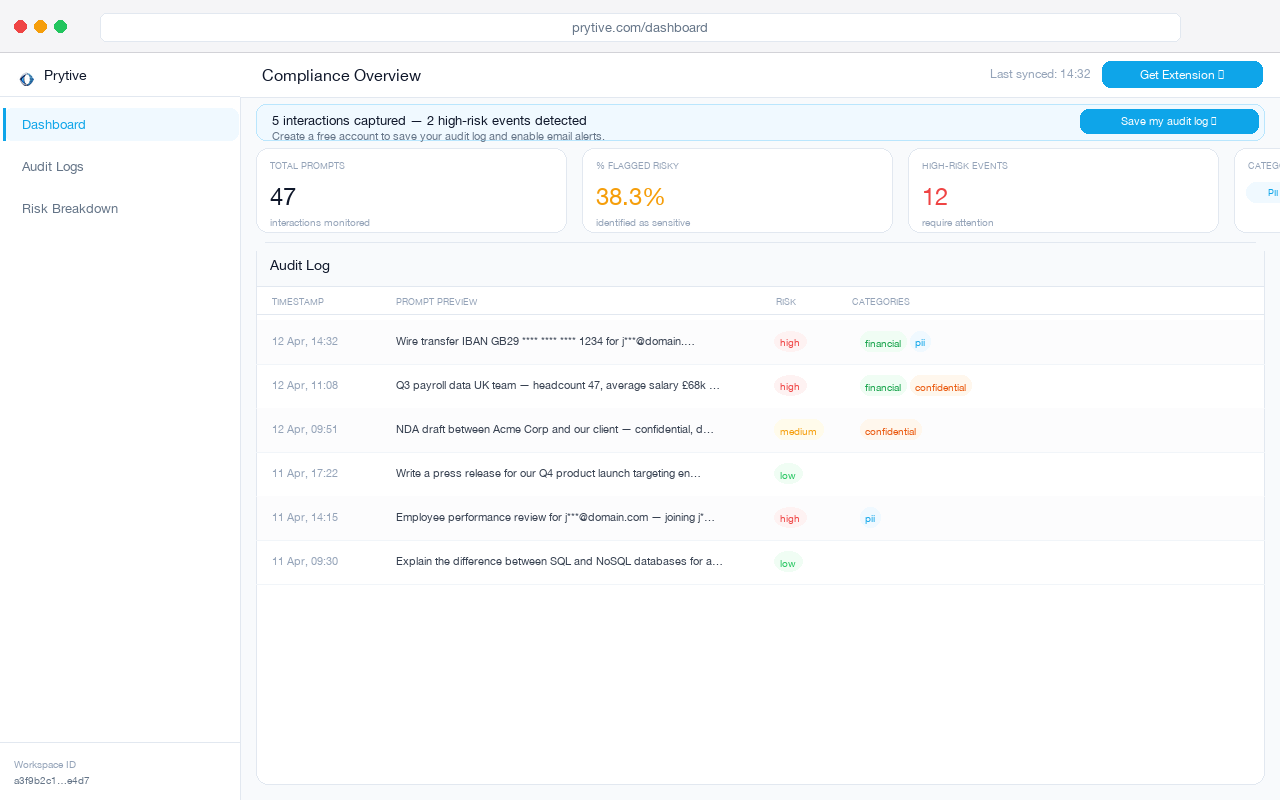
A 4-jurisdiction comparison: when does the disclosure event start?
Numeric clarity helps.
| Regime | Disclosure event | Notification clock | What "intent" buys you | |---|---|---|---| | GDPR (UK/EU) | On submission to processor | 72h from controller awareness (Art. 33) | Nothing for the disclosure analysis; relevant only to severity | | PIPEDA (Canada) | On submission | "As soon as feasible" if real risk of significant harm | Nothing for disclosure; relevant to harm assessment | | HIPAA (US) | On submission to non-BA | 60 days from discovery (45 CFR 164.404) | Nothing; HIPAA explicitly does not require intent | | Privacy Act (AU) | On submission overseas | "As soon as practicable" under NDB scheme | Nothing for the use/disclosure analysis under APP 6 |
Four different clocks. Four different scoping rules. Same answer to the question "does this count?" — yes.
The contrarian claim, restated
Most AI policy work in 2026 is built on the assumption that employees will follow it because they understand the rules. That assumption is failing in audits and in incidents because it cannot be evidenced.
The regulators are not asking whether your employees intended to comply. They are asking whether you can demonstrate that personal data is not flowing into third-party processors without authorisation. "We have a policy" is the same answer in 2026 that "we trust our employees" was in 2018 — and it carries the same regulatory weight, which is none.
The move that closes the gap isn't more training. It's evidence at the prompt layer: a redacted log, a classification, an action taken. That is what an inspector will ask for. Everything else is policy, and policy without evidence is the gap that ends in a finding.
Run a free AI prompt audit. Install Prytive on a small team for 7 days and see what your employees are actually submitting — across every regime that applies to you. → prytive.com/start