“We need more training” is still the default response after an AI-channel incident. It is also one of the least effective.
Not because training is bad in principle. Because the structure of the failure usually sits somewhere training cannot reach.
A support rep pastes PHI into ChatGPT. A claims handler drops policy details into Copilot. A legal assistant asks Claude to rewrite a draft with client names still intact. The post-incident fix is often a refresher course, a new slide deck, and an LMS completion report.
Then the same pattern returns.
That is not a mystery. It is behaviour under load.
Across behaviour-change research, awareness-only interventions tend to produce short-term improvement that fades fast. In practice, you should treat the effect like a 6-8 week half-life. People remember the policy. They may even agree with it.
Then ticket volume rises, the queue backs up, Friday hits, and the fastest path wins again.
For a DPO or Head of Compliance, that matters because GDPR does not ask whether your annual training completion rate looked healthy. It asks whether your controls were appropriate to the risk. Article 5(1)(f) requires integrity and confidentiality. Article 24 requires the controller to implement appropriate technical and organisational measures. Article 25 requires data protection by design and by default. Article 32 requires security measures appropriate to the risk.
A mandatory course helps with the organisational part. It does very little at 4:47pm on Friday.
The mechanism is not ignorance. It is ego depletion under cognitive load. When people are tired, context-switched, and trying to close work before end of day, self-control drops and they default to the shortest route to task completion. Your CS rep who pasted PHI did not forget the training. They were on ticket #34 of 40. The model was open. The answer was faster.
That is how you get a breach-shaped decision from someone who passed every compliance module.
This is why the old security line still holds: “You can’t train your way out of a structural problem.”
If the risky act is a paste into an LLM, the relevant control point is the paste. Not the Monday-morning training session. Not the annual attestation. The moment of risk matters more than the moment of explanation.
That is where proportional friction works.
A good control does not try to make every employee a privacy expert under deadline pressure. It catches likely PHI, financial data, or confidential material when the user is about to send it, then blocks, warns, or redacts based on risk. High-risk content gets stopped. Lower-risk content can be edited and resent.
The intervention lands inside the workflow, when the bad decision is about to happen, rather than weeks earlier when the policy felt abstract.
The data backs the theory. Risk does not distribute evenly across the day. It clusters around deadline pressure, queue compression, and end-of-day fatigue.
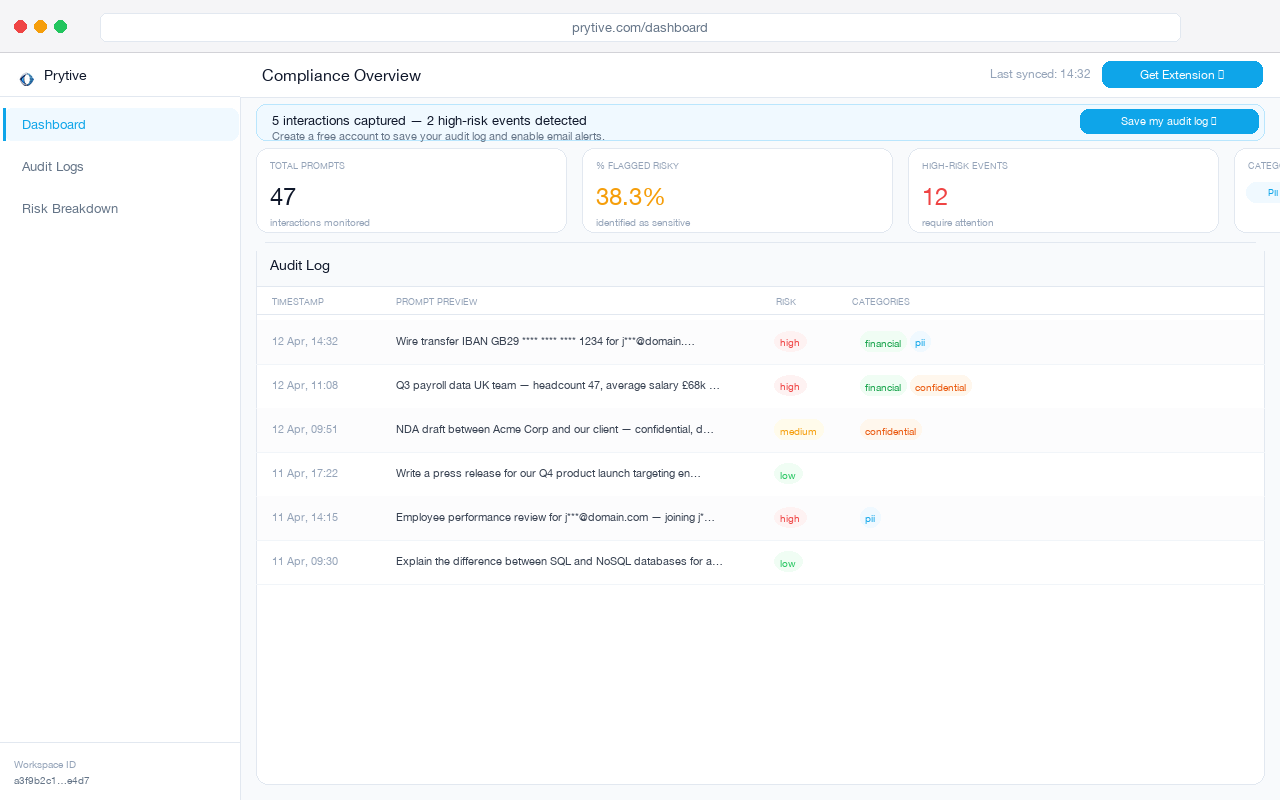
You can see this in audit data from browser-layer controls: spikes late afternoon, spikes before handoff, spikes when teams are processing high-volume repetitive work. That pattern is more useful than another 40-minute module because it tells you when compliance behaviour actually breaks down.
This is the kind of prompt that gets pasted at 4:47pm on Friday — the moment training does not reach:
Quick — help me draft a denial letter for [patient]: [details]And this one:
I have 40 tickets in my queue. Can you summarise these last three clinic complaints so I can batch-reply?Neither prompt looks malicious. That is the point. Most AI-channel exposure is not sabotage. It is throughput pressure.
That has direct implications for GDPR training effectiveness compliance behaviour. If you only measure whether staff completed training, you are measuring awareness. If you only review incidents after the fact, you are measuring damage.
What you need is evidence of near-misses and risky behaviour at the exact point where people choose speed over policy.
That evidence also closes a common governance gap. Many firms still rely on legacy DLP built for email, endpoints, and cloud storage. The browser prompt box sits outside that frame. Yet the browser is where staff now move customer data into ChatGPT, Gemini, Copilot, and Claude.
If your controls do not sit there, your policy has a blind spot exactly where pressure converts into disclosure.
Training still has a place. Use it to define rules, explain lawful handling, and show examples tied to Article 9 special category data, not generic “be careful” language. But stop treating it as the primary control. By itself, it decays. By itself, it cannot beat cognitive load. By itself, it leaves you hoping that memory outruns urgency.
What to do instead of more training
1. Put controls at the moment of risk
Intercept prompts in the browser before they reach the model. Detect PII, PHI, financial data, and confidential text as the user pastes or types. Block the worst cases. Warn on the borderline ones. Redact where the task can continue safely. This is Article 25 in practice: privacy by design at the exact interaction where data would otherwise leave your control.
2. Measure behavioural spikes, not course completions
Track time of day, risk category, repeat attempts, and team-level patterns. If high-risk prompts spike between 4pm and 6pm, that tells you more about your actual compliance posture than a 98% training completion rate. It also lets you target process fixes: staffing levels, queue design, template availability, and escalation paths.
3. Redesign work for tired humans
If your people regularly handle special category data under deadline pressure, assume shortcuts will happen. Reduce copy-paste dependence. Prebuild approved workflows for common tasks. Give teams safe summarisation paths that remove identifiers before an LLM is involved. Article 32 is about measures appropriate to the risk. For AI use, that means fewer opportunities for raw data to hit an external model in the first place.
The hard part is accepting that the incident was not caused by a knowledge gap. It was caused by a system that asked humans to make perfect decisions while depleted.
Once you accept that, your control strategy gets simpler. Keep the training. Stop expecting it to carry the load. Put your intervention where behaviour actually fails: at the paste, under pressure, late in the day, when the fastest path starts to look reasonable.
If you want a more defensible answer to GDPR training effectiveness compliance behaviour, measure the moment-of-risk data on your own team with a 14-day Prytive pilot.